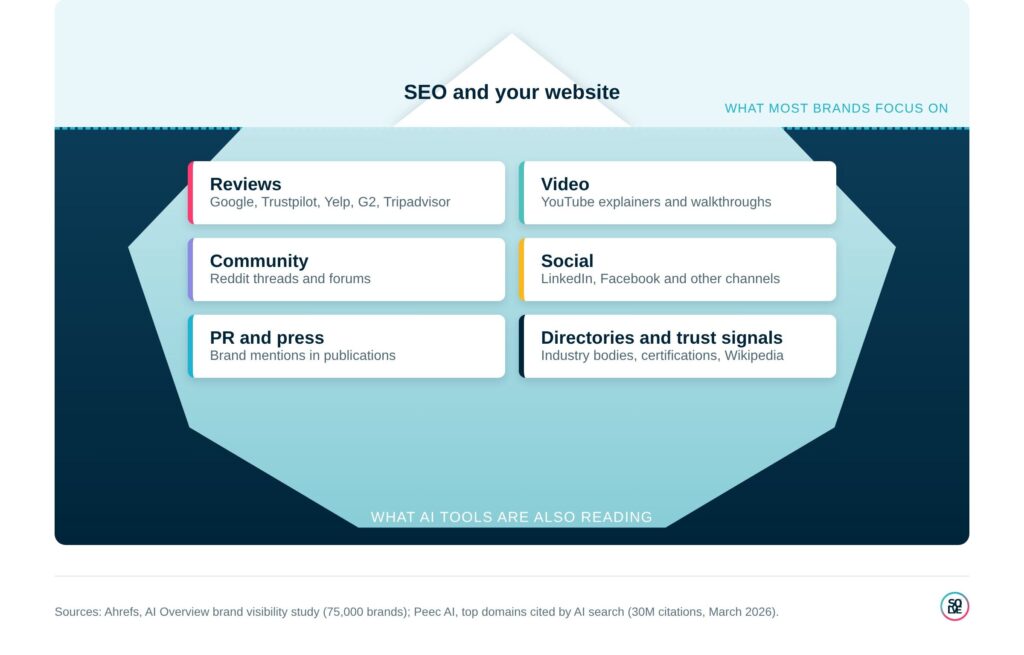
If your plan for AI visibility is “keep doing SEO”, you’re only seeing the tip of the iceberg.
AI tools don’t decide who to recommend based on your website alone. They look at your whole digital footprint: reviews, social channels, press coverage, forums and directories. In other words, digital word of mouth. SEO still matters, but it’s no longer the only thing holding up your visibility.
We’ve pulled together the latest research on how AI engines choose which brands to mention, including UK data where it exists. Alongside the data, we share what we think it means for brands and where AI search is heading.
Key takeaways:
- AI visibility is shaped by your whole online presence, not just your website.
- AI doesn’t give people a page of ten results. It gives them a shortlist, and you need to make it.
- Each AI engine favours different sources, so no single channel covers them all.
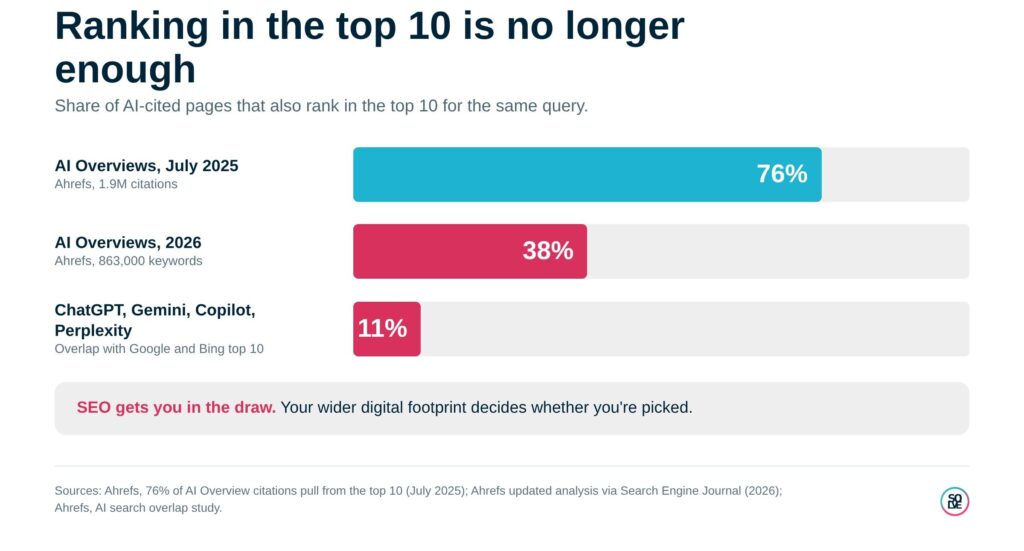
- SEO still gets you in the draw. Your wider footprint decides whether you’re picked.
Table of Contents
Staying competitive: invest in the channels your audience uses
The brands AI recommends are the ones being talked about in lots of places. The data backs this up:
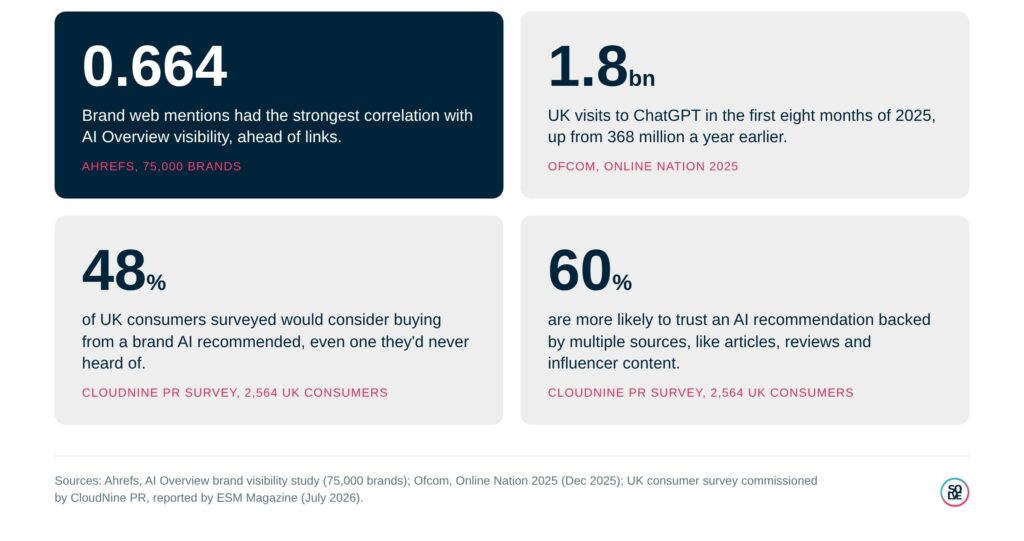
- Brand mentions beat links. An Ahrefs study of 75,000 brands found brand web mentions had the strongest correlation (0.664) with visibility in Google’s AI Overviews. Link metrics showed only moderate to weak correlations.
- UK use of AI is surging. Ofcom’s Online Nation 2025 report found ChatGPT had 1.8 billion UK visits in the first eight months of 2025, up from 368 million in the same period of 2024.
- UK shoppers act on AI recommendations. In a survey of 2,564 UK consumers, 48% said they would consider buying from a brand recommended by AI, even if they had never heard of it.
- YouTube is now a major source. Meltwater data reported by Digiday found YouTube was the most-cited platform across eight AI products in August 2026, overtaking Reddit.
- LinkedIn punches above its weight. A Semrush study of 325,000 prompts found LinkedIn appears in 11% of AI responses on average across ChatGPT Search, Perplexity and Google AI Mode.
That doesn’t mean every brand needs to be on every platform. The right mix depends on your goals and your audience. A B2B software company might focus on LinkedIn and review sites like G2. For hotels, [Peec AI found] Booking.com and Airbnb often outrank Reddit as AI sources. A local trade business will lean on Google reviews and local directories.
The question to ask isn’t “are we ranking?” It’s “where are our customers (and the AI tools they use) looking for answers, and are we there?”

Is your brand on the AI shortlist?
Find out how often AI tools like ChatGPT and Google’s AI Overviews mention your brand, and what’s shaping their answers.
Every AI engine has its favourite sources
There’s no single channel that covers every AI tool. Peec AI analysed 30 million citations across the five biggest AI search platforms, and each one leans on a different mix:
| AI platform | Top 5 most-cited sources |
| Google AI Mode | YouTube, Reddit, Facebook, LinkedIn, Yelp |
| Google AI Overviews | YouTube, Reddit, Facebook, LinkedIn, Medium |
| Gemini | Reddit, YouTube, Wikipedia, Medium, PCMag / Forbes |
| Perplexity | Reddit, YouTube, LinkedIn, Wikipedia, G2 |
| ChatGPT | Wikipedia, Reddit, Forbes, Techradar, LinkedIn |
Source: Peec AI, most-cited domains by engine, March 2026. This is US data. We haven’t yet seen an equivalent UK study, but the platforms are the same ones UK audiences use.
A few patterns stand out:
- Reddit and YouTube are the only universal signals. They appear in the top five for all five platforms.
- Google’s AI tools favour social content like Facebook and Yelp, while ChatGPT leans editorial, citing publishers like Forbes and Techradar.
- Wikipedia matters for ChatGPT and Perplexity, but doesn’t make Google’s top five.
- G2 only shows up for Perplexity, which is worth knowing for B2B brands.
- Facebook blocks Perplexity’s crawlers entirely, so a Facebook presence does nothing for you there, though it still counts on Google’s AI surfaces.
The takeaway? Each AI engine pulls from its own mix of sources, as the table above it shows. If your brand is only strong on one platform, only the AI tools that use that platform will find you. Anyone using a different AI tool won’t see you recommended.
SEO alone won’t carry your AI visibility
For years, SEO was the main lever for being found online. In AI search, it’s one lever among many. Relying on SEO alone to cover your AI visibility leaves most of the iceberg unaccounted for.
The clearest sign is how loosely AI citations now track Google rankings:
- In July 2025, Ahrefs found 76% of pages cited in AI Overviews ranked in Google’s top 10.
- By 2026, an updated Ahrefs analysis of 863,000 keywords found that figure had fallen to 38%.
- For standalone AI assistants (ChatGPT, Gemini, Copilot and Perplexity), only around 11% of citations overlap with Google and Bing’s top 10.
Why the gap? Google explains that AI Overviews and AI Mode use a “query fan-out” technique, running multiple related searches across subtopics and data sources to build an answer. So the AI isn’t just reading the results for one keyword. It’s pulling from a much wider pool, and that pool includes reviews, forums, videos and social posts.
AI mention factors: when reviews decide who gets mentioned
Beyond rankings, there’s a set of signals we call AI mention factors: the signals that decide whether your brand is mentioned at all. Two stand out.
Review gaps. One pattern we’re watching closely is the review gap. If two competing brands have very different ratings (say 4.8 stars versus 3.1 stars), the lower-rated brand is unlikely to be mentioned alongside the higher-rated one. The gap is simply too big for the AI to treat them as comparable options. BrightLocal’s US research found recommended local businesses average 4.3 stars on ChatGPT, 4.1 on Perplexity and 3.9 on Gemini. Review platforms such as Yelp, Tripadvisor, Trustpilot, G2 and Clutch also all feature among the 100 most-cited domains in AI search.
Freshness matters too. In UK research by Reputation and CGA by NIQ, 73% of consumers said they don’t trust reviews older than three months, and 26% said they already use AI to discover restaurants, pubs and bars.
Industry trust signals. Every industry has its own factors that matter most. A brand holding a relevant certification may be mentioned over a competitor with a 4.9-star rating but no certification. In some sectors, accreditations, awards or regulatory memberships carry more weight than star ratings.
The lesson is that your reputation off your website, on review sites, in industry bodies and across social channels, now directly shapes whether AI puts your name forward.
Where SEO still fits (and what happens without it)
None of this means traditional SEO matters less. If anything, it matters more, because everything else depends on it.
Google’s AI features can only cite pages that are indexed and eligible to appear in search. ChatGPT pulls live information through third-party search providers, widely reported to include Bing. If your site can’t be crawled, indexed and understood, it isn’t part of the pool AI draws from, however strong your reviews or press coverage are.
Google Search is also still where most people start. It’s used by 82% of UK adults, and around 30% of searches now show an AI Overview. Rankings still count too: 86% of AI Overview citations come from pages ranking in Google’s top 100. Those AI answers are built on top of search, not instead of it.
The technical basics are what keep you in the running, and they’re the core of any good SEO strategy:
- Let AI crawlers in. Check your robots.txt isn’t blocking OpenAI’s crawler or other AI user agents.
- Make key content readable without JavaScript. Many AI crawlers can’t render it, so important information hidden behind scripts may never be seen.
- Set up Bing Webmaster Tools. If ChatGPT relies on Bing’s index, your visibility there matters.
- Keep structured data accurate. It helps search engines and AI tools understand who you are, what you offer and where.
AI recommends, Google confirms
Strong search presence matters at the other end of the journey too. 79% of UK consumers double-check an AI recommendation before acting on it, most often by searching Google (46%), checking reviews (43%) or visiting the brand’s website (32%). Only 4% would buy from an unfamiliar brand on AI’s word alone.
So even when AI puts you on the shortlist, it’s your search presence that closes the deal. A brand that’s recommended by AI but hard to find on Google, or whose website looks out of date when people get there, loses that customer at the final step.
Taking your visibility beyond your website
The next step is making sure AI sees you everywhere else too. You can have a technically strong, well-ranked website and still be missing from AI answers.
AI doesn’t only read your website. It reads what everyone else says about you: reviews, press coverage, forums, social channels and directory listings. 60% of consumers say they trust an AI recommendation more when several sources back it up. If your website is the only place telling your story, AI has very little to go on.
That’s why SEO has had to evolve.
Enter AI SEO
AI SEO, also known as GEO, AEO or LLMO, builds on everything traditional SEO does well: the research, the technical foundations and the content strategy. It then points that work at every place AI looks. Instead of asking “how do we rank this page?”, it asks “where does our brand need to show up for AI to recommend us?”
In practice, that means using search data to guide activity across channels:
- Planning content around real questions. Search research shows what your audience is asking Google and AI tools. That becomes the brief for content that answers your customers’ questions, from blog posts to YouTube videos, LinkedIn posts and FAQs, so every channel answers the questions that lead to recommendations.
- Turning citation data into a PR plan. Different AI platforms favour different sources. Google’s tools lean towards social content, ChatGPT towards editorial publishers, and Reddit and YouTube appear across all of them. AI SEO identifies which publications, communities and sites get cited in your industry, giving your PR and outreach a clear target list.
- Earning brand mentions, not just links. Mentions across the web have the strongest correlation with AI Overview visibility, ahead of traditional link metrics. Digital PR is now part of how you win in search.
- Building trust signals. Fresh reviews, a strong Google Business Profile, and relevant accreditations and industry memberships all shape whether AI sees you as a safe recommendation.
- Measuring what AI says about you. AI SEO tracks your visibility, mentions and share of voice across AI platforms, so you can see what’s working and where the gaps are.
Where to start
Start with your goals and your audience. Which questions are your customers asking, which platforms do they use, and which sources does AI trust in your industry? Answer those, and you have a plan that connects your website, content, PR and reviews rather than treating them as separate jobs.
Traditional SEO gets you found. AI SEO makes sure you’re recommended.
Not sure where you stand? Get your free AI Readiness Check to see how visible your brand is across AI platforms and where the biggest opportunities are. Or find out more about our AI SEO, PR & Outreach and Paid Social services, and how they work together.
Is AI recommending your competitors?
Get a free AI Readiness Check and see how your brand shows up across AI search, plus which channels to focus on next.
Frequently asked questions about AI visibility
Which channels matter most for AI visibility?
It depends on your audience and industry. Across AI platforms, Reddit and YouTube are the most consistently cited sources, with LinkedIn, Wikipedia, review sites and publishers also playing a big role.
Does social media affect AI visibility?
Yes. YouTube mentions show one of the strongest links with how often AI tools mention a brand, and LinkedIn, Reddit and Facebook all feature among the most-cited sources in AI answers. Social is also where many people search: 43% of UK online adults use social media to search at least once a day.
Do online reviews affect AI recommendations?
Yes. Review platforms feature heavily among the sources AI tools cite, and businesses recommended by AI tend to have strong ratings.
Does ranking number one guarantee an AI mention?
No. Strong rankings improve your chances, but AI tools run several searches behind the scenes and pull from a wide range of sources beyond the top results.
Is SEO still worth investing in for AI search?
Yes. Google’s AI features only cite pages that are indexed and eligible to appear in search, and assistants like ChatGPT draw on search engines too. SEO is the foundation, just not the whole strategy. That’s where AI SEO comes in, extending your search strategy across reviews, PR and content.