Brand guidelines are a documented set of rules explaining how your brand should look, sound and behave wherever people meet it, from your logo and colour palette to your tone of voice and your website.
They keep every touchpoint consistent, building recognition and trust, making your website easier to use and, increasingly, helping search engines and AI tools understand who you are.
Think of the tech giant with the bitten fruit logo, or the luxury car maker with four interlinked rings. We recognise them instantly. Colour does a lot of the work too: according to a recent survey, 80% of people recognised Starbucks by colour alone, and 91% picked out Google by its red, blue, yellow and green. A brand that strong takes time, creative energy and, above all, consistency.
In 2026, people now meet your brand in more places than ever: your website, social media feeds, search results, marketplaces, email, packaging, and the answers AI assistants give about you. Brand guidelines keep all of those telling the same story.
At Solve, we work with brand guidelines daily, whether that’s making sure a new website follows an existing brand guide or creating guidelines for brands we’ve helped build. This guide covers what brand guidelines are, what to include, how to make them work for AI and user experience, and some real examples.
Key takeaways:
- Brand guidelines cover how your brand looks (visual identity), sounds (voice and messaging) and behaves (rules, governance and examples).
- Consistency across touchpoints builds trust, reduces friction for users and gives AI tools clearer, more reliable information about you.
- Modern guidelines need digital, accessibility and AI-content sections, not just a logo and a colour palette.
- Guidelines only work if people use them, so make them easy to find, easy to follow and regularly reviewed.
Table of Contents
What are brand guidelines?
Brand guidelines define your brand and explain how people should use it, both inside and outside your business. They contain instructions and standards for your visual assets, like logos, and for your words, so that everything accurately represents the identity you want to project.
They can take many forms: a PDF, a printed brochure, a video, or (increasingly, and our preference) a dedicated page on your website that’s always up to date. The right format depends on your business, your strategy and who’ll be using them.
Brand guidelines vs brand identity vs style guide vs brand book
These terms get swapped around constantly, so here’s how we use them:
| Term | What it means |
| Brand guidelines | The full rulebook for how your brand looks, sounds and behaves. The umbrella term. |
| Brand identity | The assets themselves: logo, colours, typography, imagery. Guidelines explain how to use them. |
| Brand style guide | Usually the same thing as brand guidelines. Sometimes used for visual rules only, or for written content only. |
| Brand book/brand manual | A more comprehensive, traditionally static document that often includes brand story, history and strategy. |
| Brand kit | A downloadable pack of ready-to-use assets (logos, colours, fonts, templates). |
Guidelines can be simple, covering your visual basics, or advanced, setting out your complete brand story and how to tell it.

Why brand guidelines matter in 2026
They keep your brand consistent across every touchpoint
A brand guideline is how you maintain a consistent representation of your brand when lots of people are working with it: multiple departments, agencies, freelancers, franchisees and partners. As a clear set of standards, it makes sure your logo, name, packaging, web design elements and tone of voice all come together as one identity. Take a look at Padstow Sealife Safaris and Olive & Barr for strong, consistent branding in action.
Consistency is also what makes a brand recognisable. Imagine a beauty brand selling to salons across the UK. If every salon follows the guidelines, customers see the same logo, colours and messaging online and offline. The more often people see it, the quicker they recognise it, and recognition builds trust, authority and loyalty.
They help AI tools and search engines understand you
AI assistants and AI-powered search features don’t learn about your brand from one place. They piece together a picture from your website, social profiles, directory listings, reviews and press coverage. The principle is simple: if you describe yourself in five different ways across those sources, you make it harder for anyone, human or machine, to summarise you accurately.
Consistent guidelines help here in very practical ways:
- One name, one spelling: Use the same business name, product names and service terms everywhere.
- Approved descriptions: Agree a one-line and a 50-word description of what you do, and reuse them across your site, LinkedIn, Google Business Profile and directories.
- Consistent facts: Keep details like your address, services, credentials and founding story identical wherever they appear.
- Clear terminology: If you’re a “digital marketing agency”, don’t call yourself an “SEO shop” on one page and a “web studio” on another.
- Structured data: Make sure your logo, name and social profiles are marked up properly so search engines can connect them.
This is a big part of how we approach AI SEO: clear, consistent brand signals give AI-driven search a stronger, more accurate picture to work from.
They make your website easier to use
Consistency isn’t only for machines. When your buttons, colours, headings, icons and microcopy behave the same way everywhere, people don’t have to relearn your site on every page. That reduces effort, builds familiarity and makes your brand feel dependable. It also matters at a time when people are tired of cluttered, over-designed experiences, something we explored in our piece on UX fatigue and the case for simple website design.
Good guidelines also bake in accessibility, such as colour contrast and readable type, so your brand works for everyone who visits.
They make your brand easier to work with, and easier to transfer
Brand guidelines aren’t just about control. They make life easier for anyone using your brand. Whether it’s a colleague across the office or a supplier or agency, a clear guide means no second-guessing colours or spacing, and a quicker route to work that fits seamlessly with your existing marketing.
They also make your brand more transferable across channels. Guidance on imagery, colour palettes and pre-made assets like profile banners means your brand travels from website to social to advertising without losing its identity.

What should brand guidelines include?
Logos and placement
First and foremost, guidelines cover your logo and its allowable variations. Google, for example, uses its full wordmark where there’s room and the colourful “G” where space is tight, such as on a mobile browser or app icon. You might also have colour variations for different backgrounds, and versions with or without a tagline.
Define every approved version up front to stop rogue logos appearing. Specify placement, orientation, minimum size and clear space too, and just as importantly, show what’s not allowed.
Colours
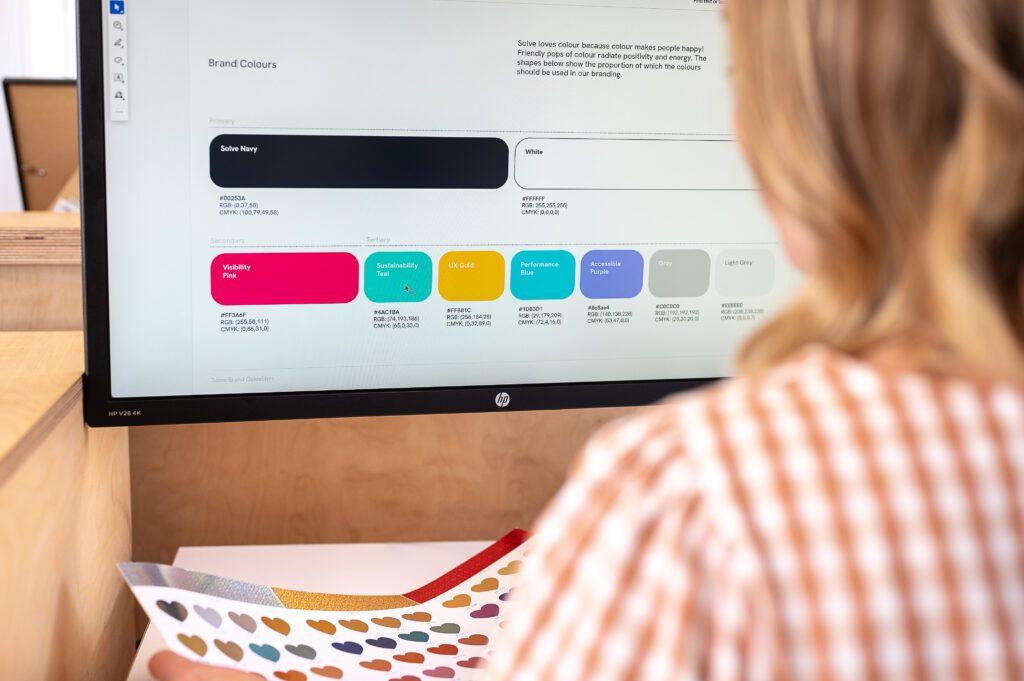
List your brand colours with exact codes so they can be reproduced accurately: Pantone for print, CMYK for print production, and HEX and RGB for screens. For digital use, also set out which colour combinations pass accessibility contrast standards (WCAG AA asks for at least 4.5:1 for normal text and 3:1 for large text).
Typography
Specify your typefaces (most brands use one to three) and what each is for, such as headings, body text and logo. For web, include web-safe fallbacks and a limit on font weights. Fewer font files mean faster pages, which supports both user experience and sustainable web design.
Photography and imagery
Photography is critical to communicating your brand’s aspirational message, particularly in B2C. Describe the style you want: colour palette, positioning, texture and mood. Product and lifestyle images usually need separate rules. For web, add practical standards for file formats, compression and how to write alt text (see our guide to image SEO).
Other brand assets and digital elements
This covers everything else you use to carry your message: icons, emblems like “vegan friendly” or “please recycle”, social profile pictures and banners, favicon and app icon, and any website interface elements such as buttons, forms and icon styles. Include platform-specific rules where they matter.
How to incorporate brand voice and messaging into your set of brand guidelines
This is where guidelines move from “how we look” to “how we sound”, and it’s what separates a basic style sheet from a genuinely useful brand guide. Here’s how to build voice and messaging into your guidelines so they’re usable day to day.
- Define your brand personality – Pick three to five adjectives, such as authoritative, helpful, welcoming, knowledgeable or enthusiastic. These are for internal understanding, so creatives can project the right tone. For each, add a short “we are / we’re not” pair (for example, “friendly, not flippant”).
- Set out your messaging – Capture your positioning statement, your three or four key messages and the proof points that back them up. This gives everyone the same answer to “what do you do and why should I care?”
- Create a glossary of preferred language – Market-ready words and phrases should be defined in a glossary. You might describe your company as a digital marketing agency rather than an SEO company, or call your audience “clients” or “partners” rather than “customers”. List taglines, key phrases, and don’t forget to mention any words to avoid.
- Add style rules – Decide how prescriptive to be: contractions or not, headline format, UK or US spelling, how you write numbers and dates, whether you use emojis. It all depends on how much control you need.
- Adapt tone to context – Your voice stays the same, but your tone flexes: a celebratory social post, a calm error message and a formal proposal shouldn’t sound identical. Note how tone shifts across channels and situations
- Show it in action – Examples teach faster than rules. For instance:
| Off-brand | On-brand |
| “We offer a wide range of solutions tailored to your needs.” | “We build websites that load fast, rank well and look the part.” |
| “Please be advised that your request has been received.” | “Thanks, we’ve got your message and we’ll be in touch within a day.” |
When your voice is defined, everyone from employees to distributors can ensure that every message stays on brand, and that consistent message goes out into the marketplace in speech and writing, online and in print. It’s also what makes your content recognisably yours, which matters even more now that so much brand content is produced with AI help.
What are advanced brand guidelines?
Advanced brand guidelines suit larger, more established businesses that want to define their whole personality and how to represent it. They’re valuable for marketers, and also work as presentation tools for employees, suppliers, distributors and customers. They can even be used to train sales and customer service teams.
On top of the basics above, they typically include:
- Brand overview: your purpose, values, history, mission, USPs and where you sit in the market.
- Target market: more than demographics. Turn your audience into real people: what motivates them, what frustrates them, what they value and how they spend their time.
- Voice and tone: as set out in the section above.
- Extended visual rules: how your brand appears on everything from boxes, bags and vehicles to uniforms and merchandise.
Brand guidelines for the AI era
Most guidelines were written before generative AI became part of everyday workflows. If your creative team (or your agency) uses AI tools to draft copy, images or social posts, your guidelines need to say how. Consider adding:
- Where AI can and can’t be used: for example, drafting and brainstorming yes, final copy without human review no.
- Your voice, ready to paste: A short voice summary and glossary people can drop into an AI prompt so drafts start closer to on-brand.
- Fact-checking and sign-off: Who reviews AI-assisted content before it goes live.
- Imagery rules: Whether AI-generated images are allowed, and if so, for what.
- Approved boilerplate: Standard company descriptions and key facts so AI-assisted drafts don’t invent new versions of you.
Brand style guide examples
To help you picture the finished product, here are five brand style guide examples, from global market leaders to smaller favourites.
- Spotify: dedicated web pages on using Spotify’s brand assets. Because it lives online, it’s easy to keep current.
- Starbucks: web pages that give a helicopter view of the branding before getting into usage detail.
- Slack: a PDF of advanced guidelines covering identity, visual assets and trademarking.
- Coast Boat Trips: simple guidelines covering logo usage, colours and fonts, created in-house by Solve. A good model for smaller businesses.
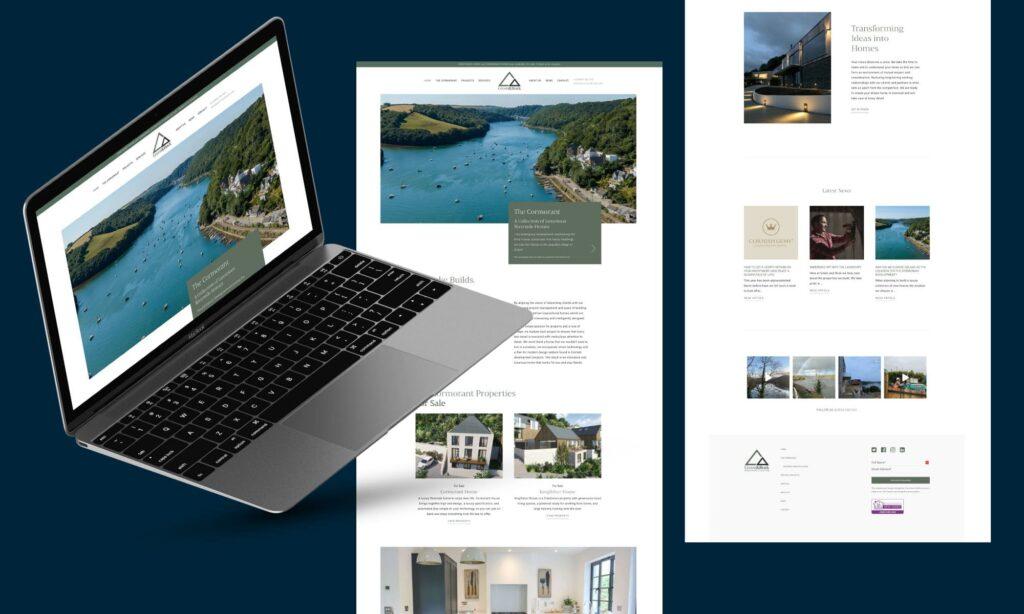
- Green and Rock: guidelines outlining logos, Pantones and typography, created by Solve.
Common brand guideline mistakes
- Writing them once and forgetting them – Brands evolve, so guidelines need an owner and regular reviews.
- Focusing only on visuals – Voice, messaging, and digital rules matter just as much.
- Making them hard to find – If people can’t locate the latest version in seconds, they’ll use an old one.
- Being so rigid nobody uses them – Explain the “why”, and show flexibility where it’s allowed.
- Skipping the “don’ts” – Examples of misuse are some of the most useful pages in any guide.
- Ignoring digital and accessibility – A palette that looks great in print can fail on screen.
How to create brand guidelines
Most creative agencies, like Solve, can prepare brand guidelines for you. In the meantime, here’s a simple process:
- Audit what you have – Gather every place your brand currently appears and note inconsistencies.
- Define the foundations –Purpose, values, positioning, audience and personality.
- Build the visual system – Logo, colours, typography, imagery and any extra assets.
- Write your voice and messaging – Use the six steps above.
- Add digital and AI sections – Accessibility, web standards, structured information and AI-content rules.
- Choose the right format – A web page is easiest to keep current; a PDF is handy for downloading. Many brands offer both.
- Launch, train and govern – Share them, show people how to use them, name an owner and review at least once a year.
To brief an agency, we’ll need to know about your brand, how you want it to come across, your target market and any creative ideas you already have, plus which assets you need.
Brand guidelines checklist
- Logo versions, spacing, minimum sizes and misuse examples
- Colour palette with Pantone, CMYK, HEX and RGB values
- Accessible colour combinations for digital use
- Typography and web font fallbacks
- Photography and imagery style, including alt text approach
- Brand purpose, values and positioning
- Target audience profile
- Voice, tone and messaging, with a glossary
- Approved company descriptions and key facts
- Social, favicon and app icon assets
- AI-content rules
- Download-ready assets and templates
- A named owner and review date
Brand guidelines to help tell your story
Now you know what brand guidelines are, why they matter more than ever, and what goes into them, with some heavyweight examples for inspiration.
If you’re still not sure where to start, or you’re ready to get going, get in touch with the geeks at Solve. From designing logos and building websites to helping your brand show up in AI search, our team of creatives is here to guide you every step of the way.

Get help creating clear brand guidelines today and turn your business into a brand people remember
Speak to Perry
Frequently Asked Questions
What are brand guidelines?
Brand guidelines are a documented set of rules that explain how your brand should look, sound and behave across every marketing channel. They cover things like your logo, colours, typography, imagery, tone of voice and messaging.
What’s the difference between brand guidelines and brand identity?
Your brand identity is the set of elements that represent you, such as your logo, colours and fonts. Brand guidelines are the rules for ensuring consistency across those elements.
Are brand guidelines and a brand style guide the same thing?
Usually, yes. Some people use “style guide” to mean visual rules only, or written content rules only, but most of the time the terms are interchangeable.
What’s the difference between brand guidelines and a brand book?
A brand book (or brand manual) is an older term for a comprehensive, often static document that may include your story and strategy. Brand guidelines are the broader, more practical term, and today they’re often living digital resources.
Do small businesses need brand guidelines?
Yes. Even a short guide covering your logo, colours, fonts and tone of voice saves time and keeps you consistent as you start working with freelancers, agencies or new team members.
How long should brand guidelines be?
As long as they need to be to get used. A small business might need only a few pages. A larger organisation with many teams and markets will need more depth.
How often should brand guidelines be updated?
Review them at least once a year, and update them whenever you launch new channels, change your positioning or start using new tools, including AI.
How do brand guidelines help with SEO and AI search?
They help you describe your business consistently across your website, social profiles and listings. That clarity makes it easier for search engines and AI tools to understand and accurately represent your brand, although no guideline can guarantee how any one tool will respond.